In short
The federal battery rebate is not a fixed discount — it shrinks on a published schedule. The next cut lands on 1 January 2027, and it's worth roughly $350 on an 8 kWh battery, $660 on 16 kWh and $860 on 24 kWh (indicative, as at July 2026, at current certificate prices). After that it steps down again every six months until the scheme ends in 2030. The rebate is set by your installation date, not the date you sign — so what matters is when the job is actually done, not when you order. That said, waiting is still the right call for some homes, and we'd rather tell you which.
Most rebate deadlines you read about are marketing. This one is in the regulations.
The federal Cheaper Home Batteries Program doesn’t pay a flat dollar amount. It pays you in certificates, and the number of certificates a battery earns falls on a fixed schedule written into law. It already stepped down once, on 1 May 2026. The next step is 1 January 2027, and then it happens every six months until the program finishes in 2030.
That means the question isn’t “will the rebate disappear” — it won’t, not for years. The question is “what does another six months of waiting cost me”, and that has a specific number attached to it.
Here’s the playbook:
- Understand what the rebate actually is, so the schedule makes sense.
- Work out what the January cut is worth on the size of battery you’d actually buy.
- Check the one detail that catches people out — the date that counts.
- Decide honestly whether to move now or wait.
1. What the rebate actually is
a) It’s paid in certificates, not dollars. Your battery earns a number of small-scale technology certificates based on its usable capacity, and those certificates are sold to fund the discount. You never handle them — a licensed installer claims them and the discount comes off your invoice.
b) The certificate count per kilowatt-hour is what falls. It was 8.4 before May 2026. It’s 6.8 now. From 1 January 2027 it becomes 5.7 — about a 16% cut. Then 5.2 from July 2027, 4.6 from January 2028, and so on down to 2.1 by 2030.
c) Bigger batteries already earn less per kilowatt-hour. The rebate pays the full rate on the first 14 kWh, 60% of it from 14 to 28 kWh, and only 15% above that. So a very large battery was never rebated at the same rate as a small one.
d) You need rooftop solar. The battery has to be attached to a solar system at the same property. A battery installed purely to store cheap grid power is not eligible.
2. What the January cut is actually worth
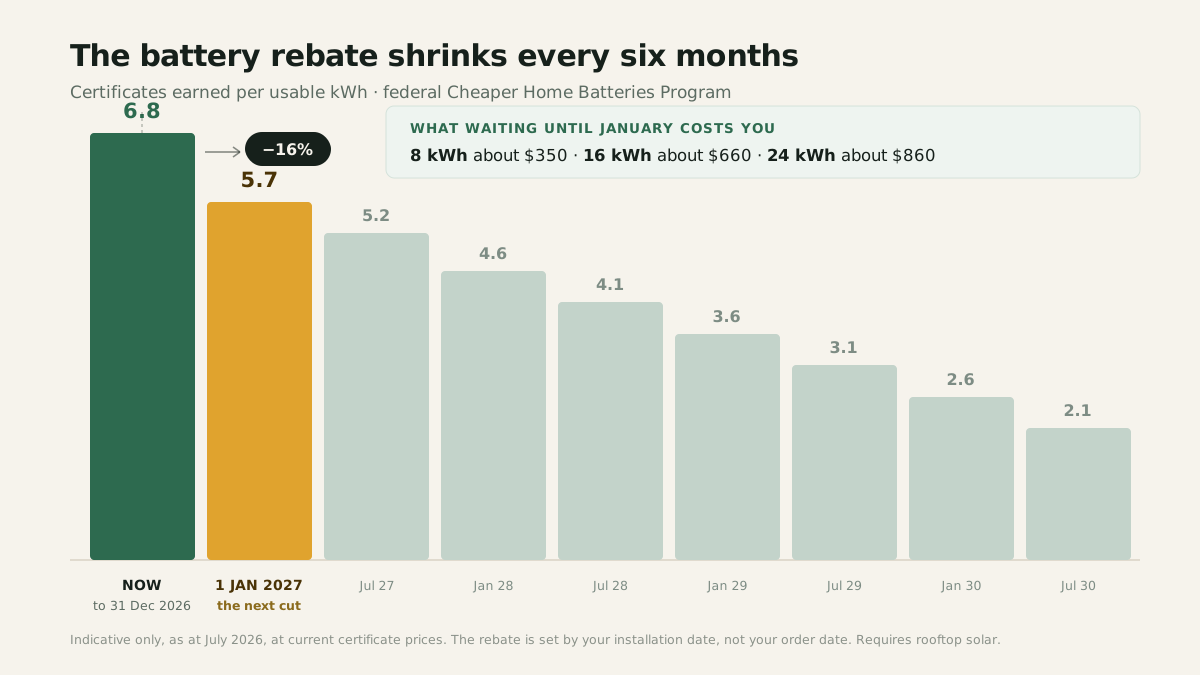
This is the number that matters, so here it is plainly. These figures assume current certificate prices and the capacity tiering above.
8 kWh battery — rebate falls from $2,106 to $1,755 — 54 certificates down to 45. You lose $351 by waiting.
16 kWh battery — rebate falls from $4,017 to $3,354 — 103 certificates down to 86. You lose $663.
24 kWh battery — rebate falls from $5,304 to $4,446 — 136 certificates down to 114. You lose $858.
(Certificate counts confirmed against the Clean Energy Regulator’s own STC calculator on the REC Registry, at $39 per certificate. Certificate prices move, so the exact figure on your quote is the one that counts.)
Will this change my mind?
- Probably yes — if you were already planning a battery in the next six to twelve months. You’re giving up several hundred dollars for no benefit.
- Probably not — if a battery doesn’t stack up for you today. A smaller rebate on a system that wasn’t going to pay for itself is still a system that doesn’t pay for itself. The rebate is a discount, not a reason.
- One thing to note — the cut is real but it is not a cliff. It’s about 16%, not 100%, and there’s another one every six months after it. If someone tells you it’s now or never, they’re selling.
3. The detail that catches people out
The rebate is assessed on your installation date, not your order date.
This is the single most expensive misunderstanding in the whole scheme. Signing a contract in December does nothing if the system goes on the wall in January — you get January’s rebate.
a) Work backwards from the deadline, not forwards from today. Between quote, equipment supply, install scheduling and grid approval, a battery job typically takes several weeks end to end.
b) Grid approval is the part you don’t control. Your network connection application sits with Energex (or Ergon, if you’re west of the range) and it takes as long as it takes.
c) So if the January rebate matters to you, the conversation needs to start well before December. Not because we’re rushing you — because the calendar is the calendar.
We’ll tell you at quote stage whether your job can realistically be completed before the step-down. If it can’t, we’ll say so rather than take a deposit and let you find out in February.
Ask us what’s still achievable before January
A worked example
A Brisbane family with an existing 6.6 kW solar system, currently exporting most of it for a few cents a kilowatt-hour.
They’re weighing a 16 kWh battery. Today, the rebate takes it from around $13,250 installed down to around $9,300.
If they install the same battery in February 2027, the rebate drops by $663 — so they’d pay closer to $9,950 for exactly the same system.
Their evening usage is around 10 kWh a day, which the battery covers comfortably. On a time-of-use plan, the power it displaces in the 4pm–9pm peak is the most expensive power they buy all day. The battery was going to make sense for them either way — so waiting six months buys them nothing and costs them $663.
Now change one thing. A different household is still saving for the deposit and would have to borrow to do it this year. For them, waiting is obviously right: $663 is not a reason to take on debt, and the rebate will still be there in 2027, just smaller.
When not to bother
- You don’t have solar. The rebate requires it. Get the solar sorted first — that’s the bigger economic lever anyway.
- The battery doesn’t pay back for you today. A discount on a bad investment is still a bad investment. We’ll show you the numbers before you commit, and we’ll tell you if they don’t work.
- You’d have to borrow at a high rate to bring the purchase forward. The interest will eat the $350–$860 you saved.
- Your evening usage is tiny. If you’re out most evenings and use very little after dark, there’s not much for a battery to displace. A hot water timer may be the better first move.
Frequently asked questions
Is the 1 January 2027 date confirmed, or is this a sales deadline? Confirmed. The step-down schedule is written into the federal regulations, running every six months from January 2027 through to the program ending in 2030. It isn’t a promotion and nobody can extend it for you.
How much is the rebate falling by? The certificate rate drops from 6.8 to 5.7 per usable kilowatt-hour — roughly 16%. In dollars that’s about $350 on an 8 kWh battery, $660 on 16 kWh and $860 on 24 kWh, at current certificate prices.
Does it matter when I sign, or when it’s installed? Installed. The rebate is assessed on installation date. A contract signed in December with a January install gets January’s rebate.
Will the rebate disappear altogether? Not until 2030, on the current schedule. It shrinks steadily rather than vanishing.
Should I rush to beat it? Only if you were buying a battery anyway. If the numbers don’t work for your house today, a slightly larger discount doesn’t fix that — and we’d rather tell you so.
Does the rebate apply if I don’t have solar? No. The battery must be paired with rooftop solar at the same property.
What to do next
If a battery is already on your list for the next year, the cheapest version of that decision is the one you make before the end of 2026 — and the honest deadline is earlier than 1 January, because it’s the install that has to be finished, not the paperwork.
If you’re not sure a battery stacks up for your house at all, that’s the more useful question, and it’s the one we’d rather answer first. Get in touch and we’ll model it against your actual bill — including what the January step-down does to your numbers — before you commit to anything.