In short
Since 1 July 2026 every big retailer in South East Queensland has to offer a plan with free power from 11am to 2pm. The catch: most other hours cost more, especially 4pm to 9pm. So it only pays if you move power use into those three hours. Do nothing and you will probably pay more. Move your hot water, washing and dishwasher there and you will probably pay less. Fill a battery there and it can take around $1,000 a year off a typical bill (as at October 2026, indicative, depends on your home and plan).
Updated October 2026 with the actual prices retailers are charging.
Free power sounds like a no-brainer. For some homes it is. For others it quietly costs more, because the plan makes up for the free hours by charging more the rest of the day.
The good news is that the difference comes down to one simple question: how much power can your house use between 11am and 2pm? Answer that, and you know whether the plan is for you.
The plan in one minute
The government’s energy regulator sets the most a retailer can charge for this plan, and every retailer in our area charges that maximum per kWh. A few take a few cents a day off the daily charge. As at October 2026, in the Energex area:
| When | Price |
|---|---|
| 11am to 2pm | Free, for the first 24 kWh a day |
| 2pm to 4pm | 8.1c a kWh |
| 4pm to 9pm | 48.9c a kWh |
| 9pm to 11am | 26.4c a kWh |
| Daily charge, just to be connected | $1.78 a day |
Two things jump out. The free hours really are free. And 4pm to 9pm, when most families cook, wash and watch TV, costs about 75% more than the standard flat-rate price (48.9c against about 28c).
A quick word on the two kinds of ordinary plan you’ll be comparing it with. A flat-rate plan charges the same price all day. A time-of-use plan charges more in the evening and less in the middle of the day.
That’s the trade. You win in the middle of the day and lose in the evening. Whether you come out ahead depends on how much you can move.
Your plan of attack
- Find out where you stand. Look at your bill and see how much power you use a day. Our power plans page shows what five kinds of home pay, refreshed every fortnight.
- Move the hot water into the free hours. This is the biggest single win for most homes.
- Put the dishwasher and washing machine on delay-start so they run at 11am.
- Charge the car in the free hours if you have one and it’s home.
- Add a battery to carry the free power into the evening. This is what turns the plan from “slightly cheaper” into “a lot cheaper”.
The hot water: the biggest easy win
Your hot water is probably the biggest power user in the house. If it heats in the free hours instead of overnight, that’s a big chunk of your bill gone.
a) Check how your hot water is wired. Many Queensland homes have the hot water on a separate, cheaper hot water plan, often running overnight (an older type of plan that runs your hot water on its own circuit). That circuit does not get the free hours. To use them, it has to come off that circuit and onto your main supply.
b) An electrician moves it across and fits a timer in the box with all your circuit breakers in it, set to heat between 11am and 2pm. It’s usually a few hours’ work.
c) The tank heats for free each day. A full tank usually lasts until the next day. On heavy days it can top up.
What it costs, what you save
Typically $300 to $600 installed, and often $300 to $500 a year saved once you’re on the free-hours plan (as at October 2026, indicative). The cheap overnight hot water rate goes, so the saving depends on how much hot water you use.
Will this work for my house?
- Yes if you have an electric storage tank (the big cylinder outside or in the laundry).
- Yes if you have a heat pump hot water system with a timer. The saving is smaller, because a heat pump uses less power to begin with.
- No if your hot water is gas or solar hot water with no electric boost.
Ask us about a hot water timer
The dishwasher and washing machine: free to do
Most dishwashers and washing machines have a delay-start button. Set them to start at 11am. A dishwasher uses about 1 to 1.5 kWh a load and a washing machine about 0.5 to 1.5 kWh.
On its own this saves roughly $100 to $200 a year (as at October 2026, indicative). It costs nothing, and with the hot water it can be enough to tip the plan in your favour.
The battery: what makes it really pay
A battery fills up for free between 11am and 2pm, then runs the house through the expensive 4pm to 9pm stretch. That swaps your dearest power for free power, every day.
a) The battery charges from the grid in the free hours. It doesn’t matter whether the sun is out, and it works even without solar panels.
b) It runs the house from late afternoon. An 8 kWh battery covers most of a typical family’s evening.
c) Most modern batteries do this automatically once the times are set in their app.
What it costs, what you save
For a typical home using 16 kWh a day, an 8 kWh battery taking about 6 kWh a day in the free hours brings the yearly bill on this plan from about $2,340 down to about $1,340 (as at October 2026, indicative, on the regulator’s set prices). The federal battery rebate takes a good chunk off the price of the battery if you have solar panels. Without panels, the rebate doesn’t apply.
Will this work for my house?
- Yes if you use a fair bit of power in the evening.
- Yes without solar, for renters or homes with a shaded roof, though the battery costs more without the rebate. See batteries without solar.
- One thing to note: some ordinary plans are already cheap in the middle of the day, about 6 to 7c a kWh. With a battery, those can come out close to the free-hours plan, so it’s worth comparing both.
The car: free kilometres
If your car is home in the middle of the day, charge it in the free hours.
- A normal power point adds about 7 kWh in three hours, roughly 40 km of driving.
- A dedicated wall charger adds about 20 kWh in three hours, enough for most people’s daily driving.
One limit to know: only the first 24 kWh a day is free. A battery plus a car charging at full speed can reach that. After 24 kWh you pay 8.1c a kWh, which is still cheap.
A worked example
A Brisbane family of four, no solar yet, using 20 kWh a day. Most of it is mornings and evenings, like most homes. Their hot water is on the main supply, not a separate hot water plan.
- On a standard flat-rate plan at the regulator’s set price: about $2,740 a year.
- On the free-hours plan, changing nothing: about $2,760 a year. Slightly worse.
- On the free-hours plan, moving 8 kWh a day into 11am to 2pm (hot water on a timer, dishwasher and washing on delay-start): about $1,470 a year.
That’s about $1,270 a year less than the flat-rate plan, for a timer and a few button presses (as at October 2026, indicative). If the hot water is already on a separate cheap hot water plan, the saving is smaller, closer to $800 a year, because that hot water was already cheap. Retailers also sell cheaper ordinary plans than the standard price, so the real gap for you may be smaller. Our power plans page compares them for five kinds of home.
When not to bother
The free-hours plan isn’t for everyone. It’s probably the wrong choice if:
- Nobody can move power into the middle of the day. Gas hot water, no pool, no car at home, no battery.
- You’re renting and can’t change how the hot water is wired.
- You use most of your power at night and can’t change that.
- You already have a cheap ordinary plan with low daytime prices and a low daily charge.
A rough guide from our comparison (October 2026, on a typical usage pattern): you need to move up to about 3 kWh a day into the free hours to beat a flat-rate plan, and roughly 4 to 9 kWh a day to beat a good time-of-use plan. The top of that range is battery territory.
Questions people ask
Is the power really free from 11am to 2pm?
Yes, for the first 24 kWh each day. The catch is that the other hours cost more, so the saving depends on how much you move.
Do I need solar panels?
No. The free power comes from the grid. Solar helps, but a battery filling in the free hours works without it.
Do I need a smart meter?
Yes. Many homes already have one. If not, the retailer arranges it.
My hot water is on the cheap overnight plan. Does it still work?
Not as it’s wired now. That circuit doesn’t get the free hours. An electrician has to move it onto your main supply and fit a timer first.
Which retailer is cheapest?
They all charge the same per kWh for the free-hours plan, because the regulator sets the maximum and they all charge it. A few are a few cents a day cheaper on the daily charge. What really differs is the ordinary plan each one sells beside it. We compare them on our power plans page.
Can I switch back if it doesn’t suit me?
Yes. The standard version has no exit fee. If you take a retailer’s own version, check its fact sheet.
What to do next
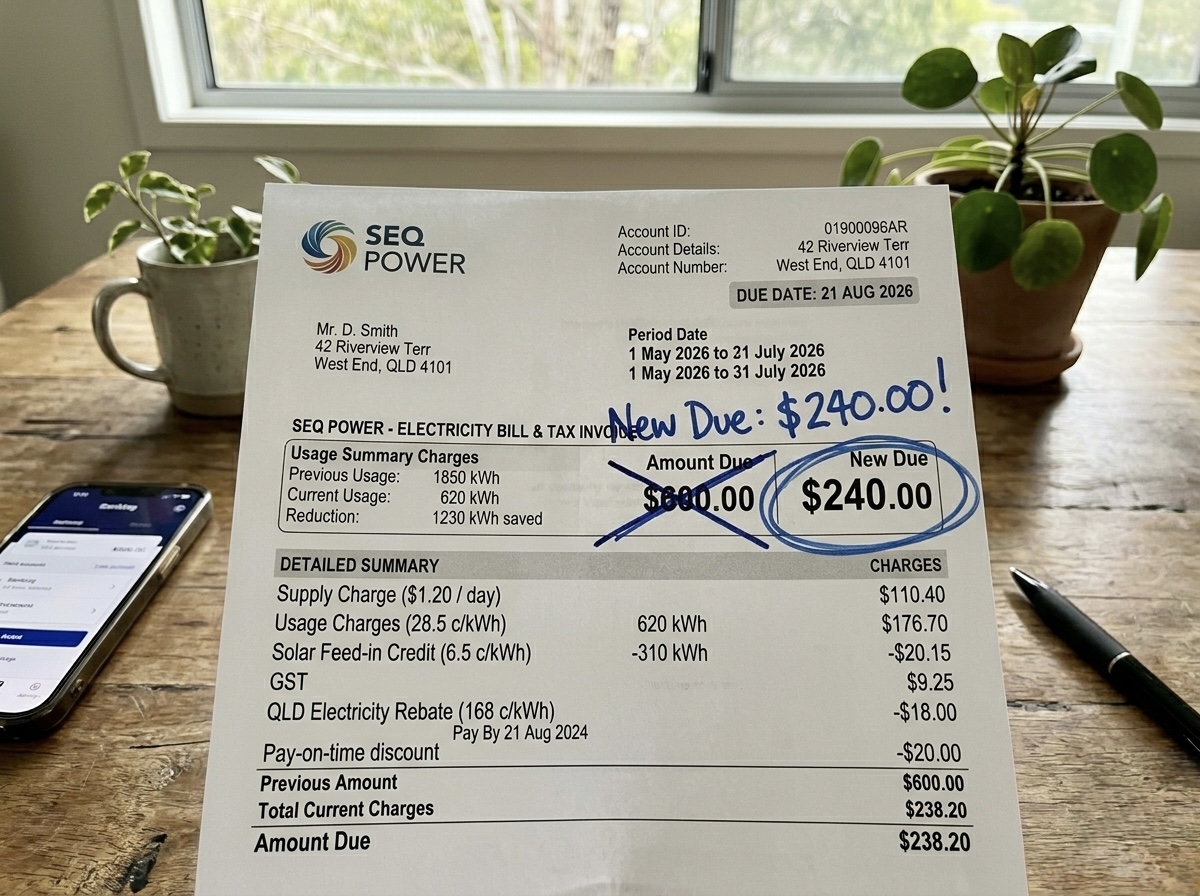
Start with your bill. Upload it on our home page and the house there will work out how much you use, when, and what a battery would do for you, in about 20 seconds.
If you’d rather talk it through, get in touch. We’ll tell you plainly whether the free-hours plan suits your house, and what’s worth doing first. We don’t recommend equipment you don’t need.
Please read before you act on this. Prices are the Energex-area figures as at October 2026, and the savings are worked out for typical homes, not yours. This article is general information to help you ask the right questions, not financial advice or a recommendation to switch. Plans, conditions and fees change, and every home uses power differently, so please check the retailer’s own fact sheet, and your own bill, before you change plans or buy anything. The final choice, and the final check, are yours.