In short
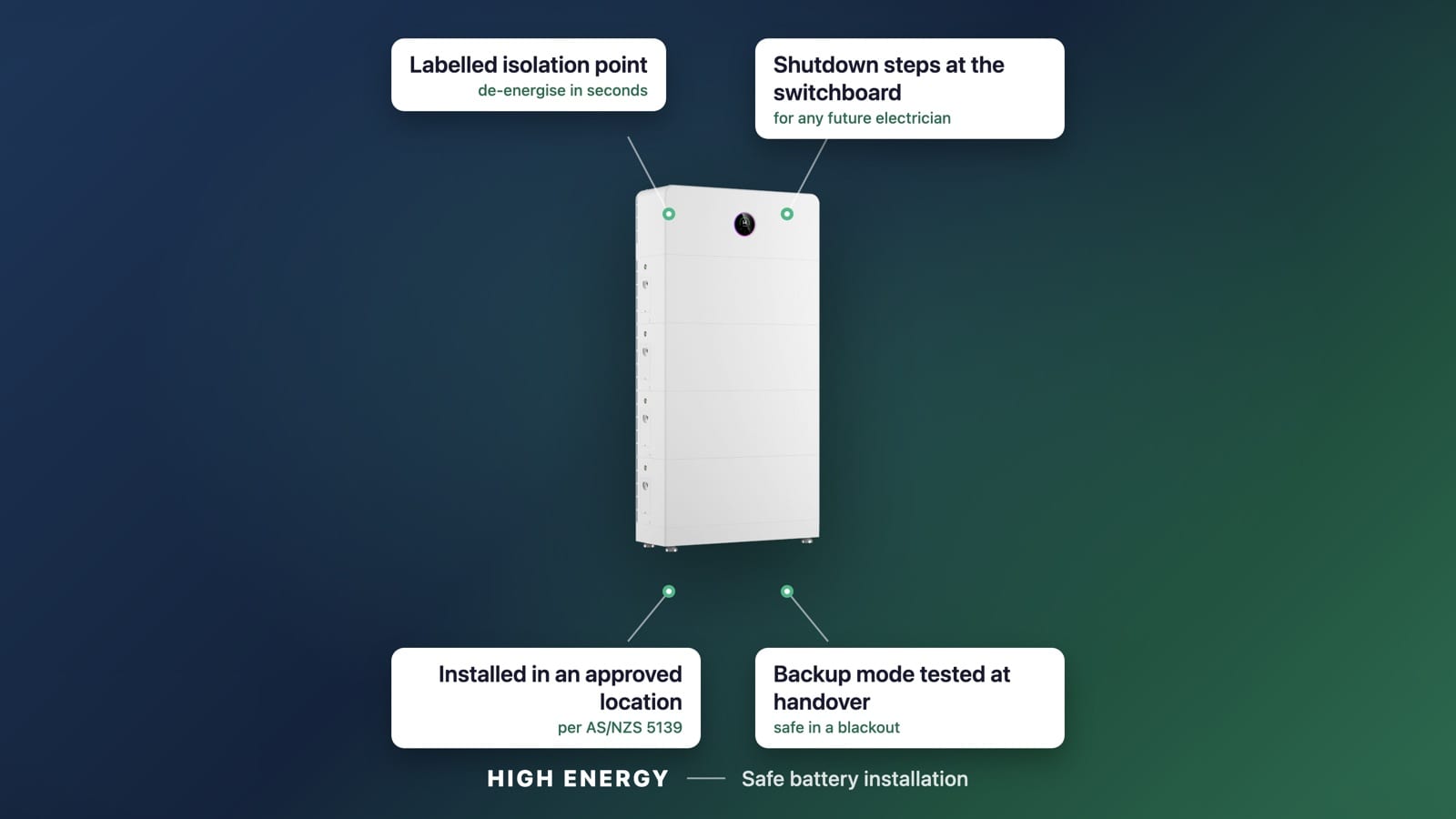
A safe battery install is about far more than mounting the box on the wall. The parts that protect your family — and any electrician or firefighter who works on your home years from now — are the ones you can't see in a photo: clear shutdown signage, an emergency isolation point, the right safety tests at handover, and a battery placed where the rules actually allow. The single most important thing to understand is that a home with a battery can stay live even when the street power is off, so a safe job makes that obvious to anyone who turns up later. Here's what a properly done install includes, and what to ask us — or any installer — to show you. Indicative of our standard practice as at June 2026; the rules themselves are set by AS/NZS 5139 and AS/NZS 3000 and applied to your specific site.
Most of the attention on home batteries goes to the things you can compare on a spec sheet — how many kilowatt-hours, how much backup, what it costs after the rebate. All of that matters. But the part that decides whether a battery is genuinely safe to live with is the workmanship you never see in the brochure: the labelling, the shutdown steps, the tests done before the installer drives away, and the decision about where the battery is allowed to sit in the first place.
A battery changes the basic assumption every electrician and firefighter is trained to make about a house. So it’s worth understanding what a careful install looks like — partly so you know your own home is safe, and partly so you can tell a thorough quote from a cheap one.
The thing most people don’t realise: your home can be live when the grid is off
For your whole life, “the power’s out” has meant the wiring in your house is dead. Switch off the main and there’s nothing left to hurt you. A battery quietly breaks that rule.
If your battery has backup — the feature that keeps your lights and fridge running through a blackout — then the home can be energised by the battery even while the street is completely dark. That’s exactly what you’re paying for. But it also means nobody can safely assume the house is dead just because the grid is off, or just because they flicked the main switch.
This matters most at the changeover switch. A battery with backup uses a transfer arrangement that disconnects your home from the grid during an outage and feeds it from the battery instead. Done properly, that switch also stops your battery from pushing power back out into the street — which is critical, because a line worker repairing the network has every right to expect a dead cable. The flipside is that, on the house side of that switch, your circuits can be live from the battery during a blackout, and they can stay live even if something has gone wrong with the battery or its inverter. A fault doesn’t necessarily mean everything has shut down. Power can still be present.
None of this is a reason to avoid backup — it’s a genuinely valuable feature. It’s the reason the rest of this list exists. Once a home can power itself, the install has to make that crystal clear to the next person who works on it.
Signage and a shutdown procedure anyone can follow
The cheapest, most important safety feature on a battery install is a few well-placed labels. Their whole job is to let a stranger — a future electrician, or a firefighter at two in the morning — understand the system and make it safe without having to guess.
It’s also where most installs fall short. As at 30 June 2026, the Clean Energy Regulator (the federal body that runs the battery rebate) had inspected 3,425 rebated battery installs and rated about 62% of them substandard. That means safe to keep running, but not meeting the Australian Standards. Missing or wrong labels were the most common reason. Fewer than 1% were rated unsafe. (Clean Energy Regulator inspection results)
A properly labelled install tells that person three things. First, that the property has battery storage at all, usually with a notice at the main switchboard so it’s the first thing anyone sees. Second, where the isolation points are — the specific switches that disconnect the battery, the inverter and the backup supply. And third, the order to operate them, written out as a plain shutdown procedure: step one, step two, step three, until the system is fully de-energised. A battery is not always something you can make safe by throwing one switch, and the sequence can matter, so it’s written down on the wall rather than left in someone’s head.
We typically place this signage where it’s actually useful — at the switchboard, at the battery, and at the isolation points — and keep it durable and legible so it’s still readable in ten years. When you’re looking at a finished job, this is the easiest quality check you can do yourself: if you can’t find a clear shutdown procedure anywhere near the switchboard, that’s worth a question.
The tests that should be done before the installer leaves
Commissioning a battery is where a careful installer earns their fee, because several of the most important checks happen after everything is mounted and wired, and none of them are visible afterwards.
One is a check on the link between neutral and earth at the main switchboard. Australian homes use what’s called a Multiple Earthed Neutral, or MEN, system — neutral and earth are deliberately tied together at that one point. Once a battery and inverter are added to the mix, we confirm there’s effectively no current flowing through that link. It should read as good as zero. A reading above that is a sign of a neutral fault somewhere — a borrowed or shared neutral, or a wiring error introduced during the install — and it gets traced and fixed before the system is signed off, because a faulty neutral-earth relationship can undermine your earthing and stop your safety switches working the way they’re meant to.
The other big one is proving the backup actually works, and works safely. We simulate a grid outage and watch the system do its job: the changeover operates, the backup circuits come alive from the battery, and — just as importantly — the neutral and earth are correctly bonded while the system is running in this islanded, off-grid mode. That last point is subtle but it’s the difference between a backup that’s safe and one that isn’t. When the grid is connected, your earthing is referenced back through the network. The moment the system islands itself during a blackout, that reference is gone unless the inverter re-establishes it. If it doesn’t, your safety switches can’t do their job during the very outage you bought the battery for. So we confirm the off-grid mode energises correctly and that a safety switch will still trip on a fault while you’re running on battery alone.
You won’t see any of this in a photo of a tidy battery on a wall. It’s the reason two quotes for the “same” battery aren’t really the same job.
Where a battery can — and can’t — go
A lot of the safety in a battery install is decided before a single cable is run, simply by choosing the right spot. The placement rules come from the battery standard, AS/NZS 5139, and they exist mostly to manage the small but real fire risk of a large lithium battery — keeping it away from where people sleep and away from the paths they’d use to escape.
In practice, a battery generally can’t go inside a habitable room like a bedroom or living room, in a ceiling space, inside a wall cavity, under the floor, or anywhere it would sit on or block an exit path out of the house. There are also set clearances to keep it away from windows, doors and vents, and from anything that could damage it. Where the only sensible wall backs onto a bedroom, the standard calls for proper fire separation between the two rather than just bolting the battery up and hoping.
Where it can go is usually more straightforward than the list of restrictions makes it sound. A garage wall, an external wall, a carport, or a purpose-built enclosure are all common compliant homes for a battery, as long as the spot is ventilated, stays within the battery’s rated temperature range, and leaves the isolation points easy to reach. In a garage where a car could realistically hit it, we’d add impact protection. The exact clearances depend on the specific battery and your specific site, which is part of what gets checked during the site assessment rather than guessed from the kerb.
If an installer is vague about why the battery is going where it’s going, that’s a fair thing to push on. The location isn’t an aesthetic choice — it’s a safety one.
What this means when you’re comparing quotes
None of the above is optional or premium. Signage, commissioning tests and compliant placement are simply what a battery install is supposed to include, and a quote that meets the standard already has them in the price. The reason it’s worth understanding is that these are exactly the things a cheaper quote can quietly skip, because the customer can’t see them and rarely asks.
So when you’re weighing up battery quotes, it’s reasonable to ask any installer to spell out the shutdown signage they’ll fit, confirm they’ll test and demonstrate the backup mode in front of you, and explain why they’ve chosen the battery’s location. Good installers are happy to walk you through it. If you’d like us to look at your home and talk through what a safe, compliant battery install would involve for your situation, get in touch — we’ll go through it properly before anything is quoted.
High Energy installs and commissions BYD, GoodWe, SigEnergy and Sungrow battery systems across South East Queensland, including the switchboard work, signage and safety testing that a compliant install requires. QLD Electrical Contractor Licence 1506492. Talk to us about battery storage for your home.