In short
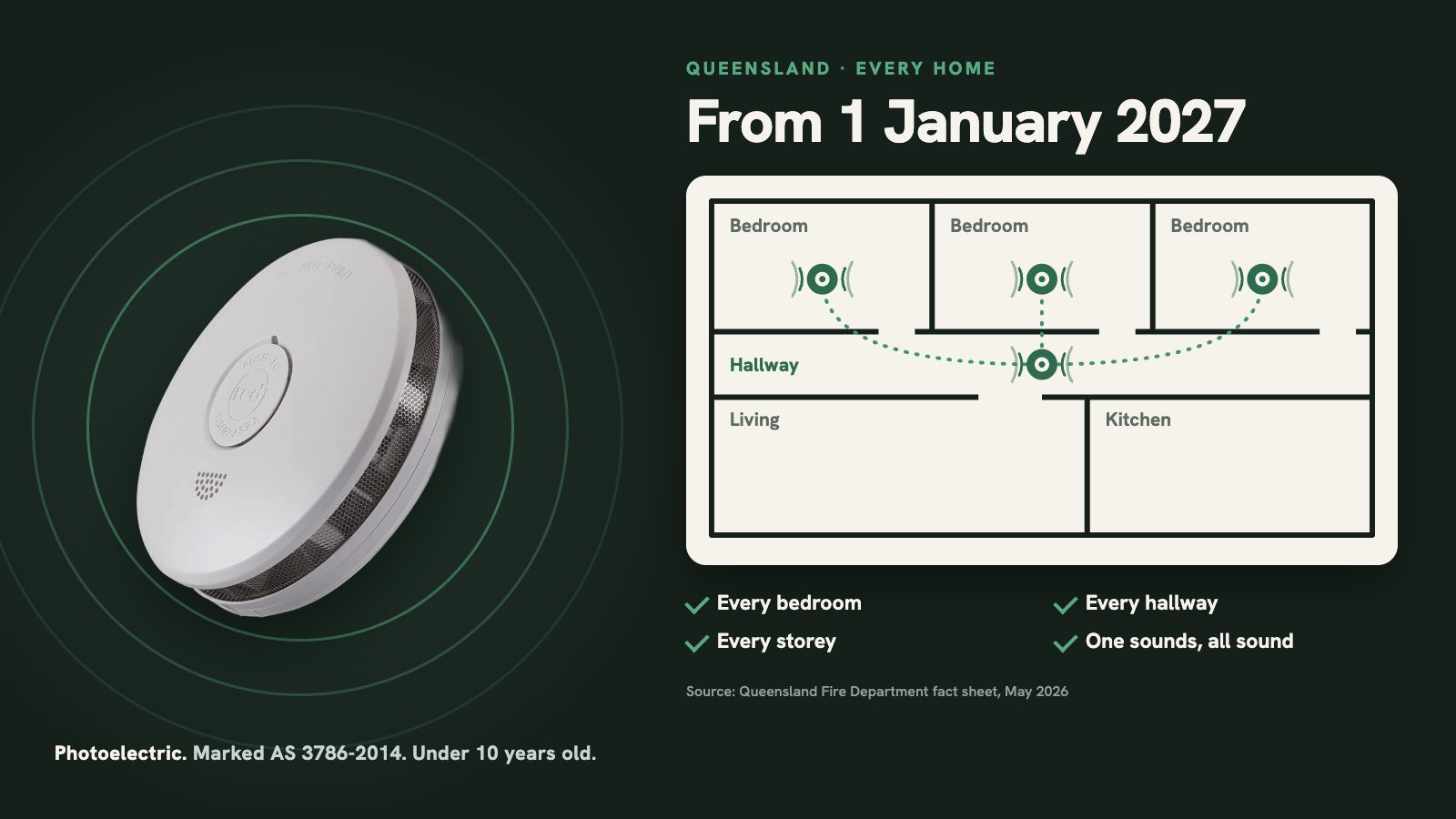
From 1 January 2027, every home in Queensland needs photoelectric smoke alarms in every bedroom, every hallway or room connecting bedrooms, and on every storey, all linked so that when one sounds they all sound. That now includes the home you own and live in. If any are wired into the house's power, the new ones must be wired in too, by a licensed electrician. Even in a battery-only home, we recommend a licensed electrician: the placement rules have edge cases that are easy to miss, and you get the peace of mind that it's done properly.
Many older Queensland homes have just one or two smoke alarms, in the hallway. Some are the original ones the house was built with. Many still work. Many won’t meet the new rules.
The point of the change is time. In a fire at night, an alarm in the hallway may not wake someone behind a closed bedroom door until the smoke is already thick. An alarm in every bedroom, linked to all the others, wakes the whole house while the fire is still small.
Rentals and homes being sold have had to meet this standard since 2022. From 1 January 2027 it’s every home. This post is what that means for yours, and why we recommend a licensed electrician does the work.
The playbook
- Check what you have. Look for AS 3786-2014 on each alarm, and check its age.
- Count the rooms. Every bedroom, every hallway or room that connects bedrooms, every storey.
- Check how they’re powered. Wired into the house, or battery only.
- Have a licensed electrician fit them. It’s the law for hardwired alarms, and the peace of mind that every alarm is in the right spot for the rest.
- Keep them working. Test monthly, clean them, replace at 10 years.
What the law asks for
The Queensland Fire Department (formerly QFES) sets out four requirements in its fact sheet. Your smoke alarms must be:
a) Photoelectric. These sense smoke with a light sensor. The older ionisation type has to go.
b) Marked AS 3786-2014. That code on the alarm shows it meets the Australian Standard the law refers to.
c) Interconnected. When one sounds, they all sound. This can be done with wiring or wirelessly.
d) In the right places. In every bedroom, in every hallway or room connecting bedrooms, and on every storey of the home.
Any alarm that contains an ionisation sensor, isn’t linked to the others, or is more than 10 years old needs replacing.
Will my current alarms do?
Here’s how to tell, alarm by alarm.
Yes, an alarm can stay if it shows AS 3786-2014, is photoelectric, is linked to the rest and is under 10 years old.
No, it needs replacing if it’s ionisation, stands alone, or is past 10 years. The date is often printed on the alarm itself.
One thing to note: the gap we see most often isn’t the alarms you have. It’s the ones you don’t. A three-bedroom house with one alarm in the hallway needs at least three more, one in each bedroom, and all four linked.
Who should fit them
Our advice is a licensed electrician, whatever you have now. Here’s why, case by case.
a) Hardwired homes. If any of your alarms are wired into the power, the replacements must be wired in too, and the Fire Department says that work must be done by a qualified electrician. Many Queensland houses have at least one, often in the hallway.
b) A mix. Many homes end up with hardwired alarms where the old ones were and wireless ones added in the bedrooms. That’s fine, as long as every alarm in the house is linked so they all sound together, which takes an electrician for the hardwired part.
c) Battery-only homes. The Fire Department says wireless alarms with a built-in 10-year battery can be installed yourself. The catch is that the rules don’t stop at which rooms. Queensland’s smoke alarm regulation also sets how far an alarm must sit from the corner of a wall and ceiling, from light fittings, air-conditioning vents and ceiling fans, and has separate rules for sloping ceilings, exposed beams and stairways. Get one wrong and the house doesn’t comply, even with an alarm in every room.
A licensed electrician like High Energy knows those rules, places every alarm to them, links and tests them all together, and leaves you a written record. That’s the peace of mind you’re paying for.
What it costs, what you get
Our fixed price, as at November 2026, is $595 for four alarms, installed, and $150 for each one after that, including GST. A typical three-bedroom, single-storey house needs four: $595 all up.
That covers alarms from Red Smoke Alarms, an Australian brand: photoelectric, AS 3786-2014, with a sealed 10-year lithium battery and wireless linking. Fewer than four alarms, or replacing a hardwired alarm like-for-like, is quoted for your house, because it depends on what’s in the ceiling.
You also get:
- a written compliance record for your insurer and for the day you sell
- a free look over your switchboard and safety switches while we’re there
Not sure what you need? Send us a photo of each alarm you have and a rough sketch of the bedrooms and hallways, and we’ll give you a fixed price.
Indicative, standard installation. Your fixed price is confirmed before any work starts. See the full offer.
A worked example
Take a single-storey, three-bedroom house with one hardwired alarm in the hallway, fitted when the house was renovated about 12 years ago.
a) The hallway alarm is over 10 years old, so it goes. Because it’s hardwired, its replacement must be hardwired, by an electrician.
b) The three bedrooms have nothing. Each gets a wireless photoelectric alarm.
c) Everything is linked, so smoke in any bedroom sets off all four.
That’s four alarms. The three bedroom alarms are standard; the hallway swap is the part we price on the day, once we’ve seen the wiring. The job takes about an hour and a half.
Keeping them working
The Fire Department asks for four simple things once they’re in:
- test them every month
- clean away dust and insects with a vacuum or brush
- don’t block or cover them
- never paint over them
And replace each one when it reaches 10 years old.
What to do next
Check your alarms this weekend. Look for the code, the date and how they’re powered, and count your bedrooms.
Then ask for your fixed price or call 1300 025 975, and have it done once, properly and on record before 1 January. We’ll tell you exactly what your house needs and give you a fixed price before we start.
Requirements as set out in the Queensland Fire Department (formerly QFES) fact sheet "Smoke alarm laws are changing in Queensland" (QFE00206, May 2026), its smoke alarm pages at fire.qld.gov.au, and the Building Fire Safety Regulation 2008, sections 55C to 55E (placement, power and alarm type), as at November 2026. Pricing as at November 2026, including GST, for a standard installation.